



What Is an AI Software Engineer?
Artificial intelligence (AI) has become indispensable in software development. Its importance has increased rapidly, especially recently. The AI Software Engineer combines expertise in product and software engineering with the latest AI technology. With technical thinking and a solid understanding of product development, they bridge the gap between engineering and product management.
What Does an AI Software Engineer Do?
As a key technical figure in the product team, the AI Software Engineer is responsible for translating product visions into working code. At their core, they are a software engineer. However, unlike a traditional developer, they don’t simply translate requirements into code, but rather adopt a holistic product perspective. Their work encompasses the following skills and tasks:
Product Skills
Unlike traditional software developers, AI software engineers possess a comprehensive understanding of the product – skills traditionally associated with product management or product ownership. They understand how to analyse the actual needs and problems of users, formulate hypotheses, and quickly validate them using user-centred prototypes. The resulting feedback is directly incorporated into further development and forms the basis for the product roadmap and backlog.
AI Software Engineering
The core competency of this role remains the development of products at the highest technical level. Solutions are implemented based on clean and proven architectures, and it is ensured that the appropriate design patterns and principles are applied.
Unlike the traditional developer role, the AI Software Engineer uses the latest AI tools and integrates them specifically into all relevant software disciplines – be it in development, testing, error analysis or deployment.
In addition, suitable tasks are outsourced to AI agents, which, for example, suggest code blocks, automatically create pull requests, or even independently conduct reviews.
AI Governance
Another key task is to monitor and evaluate the AI’s output and decisions. If necessary, the AI software engineer intervenes to minimize potential risks or counteract them proactively. Furthermore, the AI must always operate within the applicable legal framework.
How to Become an AI Software Engineer: Training and Further Education
Becoming an AI Engineer for Software: Training and Further Education
There is currently no dedicated degree program or vocational training program for AI software engineering. A traditional technical degree – such as in computer science or business informatics – provides only limited exposure to the latest knowledge in the field of AI engineering. The field is still developing dynamically and is constantly evolving.
Therefore, intensive further training in the form of a multi-month AI Engineering Bootcamp is particularly attractive: It makes it possible to deepen knowledge in this new field and to benefit from the experience of leading tech companies.
The latest AI tools make it easier to enter software development in some respects. They primarily help newcomers to better understand the complex code of large software products and to learn and deepen their programming skills. Nevertheless, it’s not typically a career path one enters via a career change. Rather, it’s usually chosen by individuals who have already gained several years of experience in software development and acquired the fundamental knowledge – and who now want to systematically expand and update their skill set.
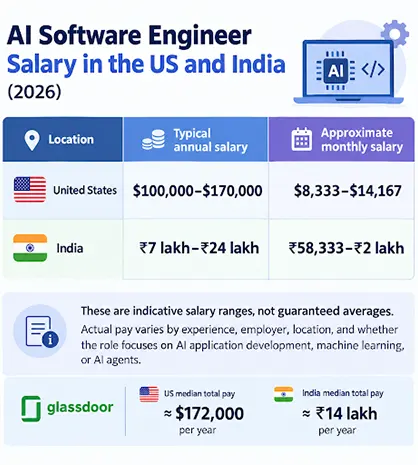
What does an Agentic Software Engineer earn?
What Tools Do AI Software Engineers Use?
Various tools play a central role in the daily work of an AI software engineer. These provide support throughout the entire product lifecycle, from ideation and discovery through design to AI-supported development.
| Tool category | Examples | Main purpose |
| Collaboration | Notion, Miro, Jira | Team communication and project management |
| User research and testing | Useberry, Hotjar | User feedback and behavior analysis |
| Design and prototyping | Figma, Lovable, Replit | UI design and application prototyping |
| AI coding assistants | GitHub Copilot, ChatGPT, Gemini | Code suggestions and development support |
| AI-enabled IDEs | Cursor, Windsurf | AI-assisted coding and debugging |
| AI orchestration | CrewAI, LangChain | Coordinating AI models and agents |
| Workflow automation | Make, Zapier | Connecting applications and automating tasks |
Collaboration Tools
Tools that enable communication and the organization of teamwork. Typical examples include Notion, Miro, and Jira.
User Research and UI Testing Tools
Useberry allows you to upload clickable prototypes, for example from Figma, and have real users interact with them. This allows you to gather feedback from real users at an early stage. With Hotjar, you can record individual user sessions and use them to derive improvements.
Design Prototype Tools
Figma allows you to quickly create clickable prototypes and UI designs that teams can test and develop in real time. Using tools like Loveable and Replit, you can directly link these prototypes to code, transforming design drafts into functional applications.
AI Assistants and Generative AI Tools
In addition to general Large Language Models (LLMs) such as ChatGPT and Gemini, software engineering also uses specialised AI assistants. Tools like GitHub Copilot, for example, support developers by providing code suggestions in real time while programming, completing functions, and generating entire code blocks.
Integrated Development Environment Tools
An Integrated Development Environment (IDE) combines a code editor, debugging, and version control into a single interface. Tools like Cursor or Windsurf extend traditional IDEs with AI-powered features that automatically complete and refactor code, actively assisting in problem-solving.
AI Agent Orchestration Tools
Tools like CrewAI and LangChain coordinate different AI models, data sources, and agents so that complex workflows can
Workflow Automation Tools
This category includes tools that connect processes and automate workflows, such as Make or Zapier. The latter allow users to connect different software applications without having to program.
AI Software Engineering: Future Skills and Career Trends
AI skills will become mandatory in the daily work of developers. Nevertheless, there are numerous job postings targeting this profile – and the trend is rapidly increasing. Typical titles in job advertisements are “AI Engineer”, “AI Software Developer”, or “Agency Software Engineer”. It can be assumed that the profession of software engineering will be inconceivable without artificial intelligence in the future. The confident handling of AI systems and multi-agent design will become as commonplace as working with databases or programming languages is today.
Continue Reading: