



If there’s one thing we’ve seen very clearly at Profile in recent months, it’s that the shift in web analytics isn’t a future trend but a reality already directly impacting how we work. On the one hand, we’ve witnessed a gradual decline in cookie acceptance, reducing our ability to measure sessions, users, and behaviour with the level of detail we were accustomed to. On the other hand, the search ecosystem itself is changing: with the emergence of experiences like AI Overviews, many users consume content directly on Google without ever visiting the website. This has the direct consequence of making it increasingly difficult to measure accurately using traditional models. And this is where the cookieless analytics approach gains traction; it’s no longer a future option but a current necessity.
When Measuring Is No Longer Enough
In our case, we reached a point where we had data, but it was becoming less and less reliable. And most importantly, it was becoming increasingly difficult to answer key business questions: what content is truly engaging, which topics perform best, or how user behaviour is evolving.
This forced us to rethink the model. We stopped focusing solely on metrics like sessions or users and started working with a more realistic approach: combining observed data with modelled data, strengthening first-party data, and relying on tools like Google Analytics 4.
Data modelling was also key here, and my colleague Jorge’s help was essential. Understanding how these models work and how to interpret the data they generate isn’t trivial, but once you do, you begin to recover something fundamental: real analytical capacity even in an environment of incomplete data.
That’s why I’m writing this article, because I know that many people are in this same situation and need to continue understanding user behaviour to develop successful digital marketing campaigns and strategies.
The End of the Cookie-Based Model
For years, web analytics has relied on cookies to identify users and reconstruct their behaviour. This made it possible to measure virtually everything.
Today, that model is losing ground. Privacy restrictions, user behaviour, and technological changes are pushing towards a model where cookieless tracking in GA4 is becoming increasingly relevant. You can no longer assume you’ll have all the data, and that completely changes the way things work.
The New Paradigm: Cookieless Analytics and Modelled Data
The change is not just technical; it’s conceptual. We’ve gone from measuring everything exactly to working with a hybrid model where real and estimated data coexist.
This is where cookieless analytics becomes relevant:
- Observed data (users who accept cookies).
- Inferred data (users who do not).
- AI models that connect both.
Tools like Google Analytics 4 are already designed for this approach, allowing you to work with Google Analytics 4 without cookies in many scenarios.
How to Do Tracking Without GA4 Cookies
Adapting to this new context means changing how you implement analytics. It’s not a single action, but a set of decisions that work together.
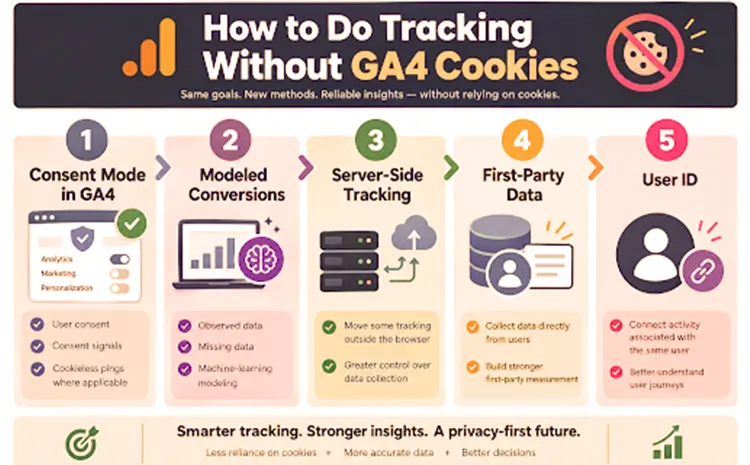
1. Consent Mode GA4
Consent Mode GA4 can be a first step towards working in a cookieless environment while still maintaining visibility.
It allows consent signals to continue being sent to Google Analytics 4 when the user does not grant consent, depending on the Consent Mode implementation. These signals do not include a persistent user identifier, but they can help with modeling and aggregated measurement.
| Scenery | Result |
| User accepts cookies | Full details |
| User rejects cookies | Anonymized data + modeling |
This point is key in any GA4 cookie-free tracking strategy, because it can help reduce data loss from the source.
2. Modeled Conversions: Understanding What Is Happening
One of the great advantages of working with Google Analytics 4 with cookieless measurement is the ability to model conversions.
GA4 uses machine learning to estimate what happened to users who weren’t directly measured. This allows for continued analysis of content and campaign performance even when the data is incomplete.
In our case, this feature has been key to understanding what content continues to work, even with less direct visibility.
| Before | Now |
| Exact data | Estimated data |
| Direct measurement | Modeling |
| Focus on number | Focus on trend |
3. Server-Side Tracking: More Control in a Cookieless Environment
Server-side tracking is a natural evolution within any cookieless analytics strategy. It allows some tracking to be moved outside the browser and work in a more controlled environment, reducing blocking and improving data quality.
It is not essential in all cases, but it is one way to strengthen cookieless tracking in GA4.
4. First-Party Data: The Most Important Asset
In a cookie-less environment, first-party data becomes key. This is where many strategies fail if they don’t adapt. Working with first-party data means shifting from relying on volume to focusing on understanding the user.
This translates into a greater focus on data collection, more valuable content, and better connectivity between tools. It’s the foundation for any truly effective cookieless analytics strategy.
5. User ID: Understanding Real Behaviour
Using unique identifiers allows you to reconstruct user behaviour without relying on cookies. This is especially useful in environments with logins.
With a user ID, you can better understand the user journey and improve the quality of the analysis, something fundamental when working in a Google Analytics 4 model without cookies.
The Role of AI in Current Analytics
Some parts of this model rely on artificial intelligence. Without it, working with incomplete data would be extremely difficult.
We used to measure almost everything, but now there are gaps, users who don’t accept cookies, and data that simply isn’t coming in. This is where AI helps, allowing us to understand what’s happening even without all the information. In other words, if it detects that certain behaviours tend to lead to conversion, it can estimate that other users with a similar journey will also convert, even without the exact figures.
The goal isn’t to invent data but to get as close to reality as possible with what you have. This is what we see, for example, in Google Analytics 4 with modelled conversions.
Ultimately, cookieless analytics is about understanding enough to make informed decisions.
Also Read: The Future Of Business Analytics: Unleashing The Power Of Data