


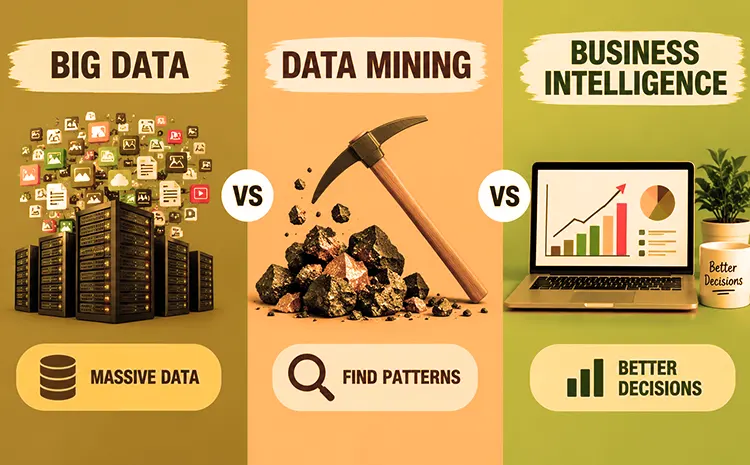
Business circles constantly repeat certain terms borrowed from the world of technology. This is the case with “Big Data”, “Data Mining”, and “Business Intelligence”. “But do you really know what they mean, and above all, are you using these terms correctly?
All these technologies facilitate data analysis, providing a wealth of valuable information to both managers and executives. To help you understand each one and their differences, we’ve listed the main characteristics of “Big Data”, “Data Mining”, and “Business Intelligence” below.
What Is Big Data?
‘Big Data’ is a term used in the information and communication technology sector to refer to a set of data that is so large and complex that non-traditional computer applications are needed to process it properly. For example, finding recurring patterns in this data requires more sophisticated procedures and specialised software.
Key Characteristics of Big Data
The main characteristics of Big Data can be summarised as follows:
- Volume: The large amount of data that is generated and stored.
- Variety: The different ways in which data can be used.
- Visibility: Describes the nature and type of data, helping professionals analyse and use it efficiently. Conventional data was structured and could be organised in a simple database. With the rise of Big Data, data comes in new, unstructured forms, making it more difficult to process.
- Speed: This parameter refers to the rate at which data is received and (possibly) at which some action is applied Accuracy: The quality of the captured data affects the results of the analyses. captured.
- Value: The information generated must be useful.
How does Big Data support business analysis?
Big data, when processed correctly, provides valuable information and answers to everyday situations in companies. For example, what was the impact of the new recruitment software used by Human Resources on the performance of other departments? Or how do customer reviews from the last six months relate to sales figures?
Analysing sources from large documentary databases fosters relationships between all facets of the company.
Also Check: Big Data: Benefits, Use Cases, And Challenges
What Is Data Mining?
Data mining is a field of statistics and computer science. It refers to the process of discovering patterns in large datasets.
These techniques and technologies enable the exploration of large databases, either automatically or semi-automatically, with the primary goal of identifying patterns of repetition, trends, and rules that explain the behaviour of the data in that specific context.
Data mining should not be used as a general term for large-scale data processing or computer systems that facilitate decision-making.
Key Steps in Data Exploration
In data exploration, each case may differ from the previous one, but the common process has the following steps:
- Data selection
- Analysis of data properties
- Transformation (or preprocessing) of input data
- Knowledge Extraction
- Interpretation and evaluation of the data
Five Phases of a Data Mining Project
Data mining projects consist of five phases:
- Understanding Phase: Both of the businesses and the problem that needs to be solved.
- Determination, obtaining and cleaning phase: Evaluation of the necessary data.
- Mathematical model creation phase.
- Validation and Communication Phase: Communicating the results obtained.
- Integration Phase: (Only if applicable) Integration of the results into a transactional or similar system.
Benefits of Data Mining for Businesses
Generally, the main benefits of data mining derive from the ability to discover hidden patterns and relationships in data, which, when used properly, can be used to make predictions that improve business procedures.
Also Check: The Role Of Data Mining In Predictive Maintenance In The Automotive Industry
What Is Business Intelligence?
The term ‘BI’ refers to the use of corporate tools and strategies that transform data into knowledge, with the ultimate goal of optimising the decision-making process for professionals in an organisation.
The concept of business intelligence combines data (information), both internal and external, collected from different sources. For example, the information an organisation gathers about the manufacturing of its products is considered business intelligence. But, at the same time, so is a study of competitor results, a report on a new market or sector the company wants to enter, or information obtained from IoT (Internet of Things) devices and social networks.
Advantages of Business Intelligence
The main advantages of using BI tools can be summarised in four key points.
- Greater capacity to analyse all information, both internal and external, from different systems and sources in a combined way.
- Improved analysis and optimisation of reports.
- Ability to analyse historical data using historical databases.
- Possibility of making projections and forecasts into the future based on all the information collected.
Common Business Intelligence Tools and Systems
Common business intelligence tools and systems include:
- Balanced Scorecards: They facilitate the monitoring of a company’s objectives and its different areas.
- Decision support systems: These tools support data analysis and decision-making using data from one or more sources.
- Executive Information Systems: These solutions are characterised by providing professionals with quick and effective access to shared information through visual and intuitive graphical interfaces. They typically include alerts and reports, as well as historical data and trend analysis.
How Does Business Intelligence Support Databases? Decision-Making?
Business Intelligence (BI) systems are designed to query and gather more information about databases. A comprehensive business intelligence solution will allow us to monitor our company’s activities, understand what is happening, facilitate prediction, help us work as a team, and enable us to choose the right path to develop effective strategies.
Also Check: The Five Critical Phases Of Business Intelligence
Differences Between Big Data, Data Mining and Business Intelligence
| Aspect | Big Data | Data Mining | Business Intelligence |
| What it is | Large and complex datasets | Process of discovering patterns in data | Tools and strategies for turning data into useful insights for decision-making |
| Main purpose | Store and process large, complex datasets | Identify patterns, relationships, and trends | Support analysis and business decision-making |
| Focus | Data volume, variety, speed, accuracy, and value | Pattern discovery and analysis | Reporting, analysis, monitoring, and decision support |
| Typical outcome | Data that can be processed and analysed | Patterns, relationships, and predictions | Insights that support business decisions |
| Relationship | Provides large and complex datasets for analysis | Can analyse data to discover useful patterns | Can use data and analytical results to support decisions |
Conclusion
When we talk about business intelligence, big data, and data mining, we understand that these are three different concepts that coexist within the same sphere. Business intelligence, big data, and data mining are related but distinct concepts. Big Data information is extracted and analysed, resulting in benefits for business intelligence activities. Data mining identifies patterns and establishes relationships within the data.
While these three concepts differ, BI, Big Data, and Data Mining all work together to provide data-driven insights. They are tools that can lead to a greater understanding of businesses and, ultimately, to more streamlined processes that increase productivity and business performance.