



Data itself isn’t particularly valuable. It becomes valuable when it is structured and analyzed to produce useful insights. However, data in itself isn’t particularly valuable. It only becomes truly valuable through someone who structures it and draws the right conclusions. This is precisely where the data scientist comes in. But what exactly does a data scientist do? What degree do you need, and is it possible to work without one? What’s the starting salary really like?
What Does a Data Scientist Do?
Which customers are likely to cancel their contracts next quarter? How many spare parts will we need in March? Which machine is about to break down? Which of the marketing department’s three proposals will actually generate more revenue? All these questions and many more can be answered with data.
The data scientist’s task is to collect and clean this data and derive sound insights from it. In doing so, they provide data-driven insights that can help companies make informed decisions. The profession thus lies at the intersection of three core areas:
- Statistics and mathematics: Mathematical methods provide the foundation. They are necessary to recognize patterns in data and derive reliable conclusions from them. This also includes calculating how certain these conclusions actually are.
- Programming and data technology: Companies accumulate vast amounts of data. To structure this data, it is necessary to program queries. Artificial intelligence (AI) is increasingly being used for this purpose.
- Technical and business acumen: Asking the right questions requires a certain level of economic understanding and entrepreneurial thinking. Data scientists work closely with product management in this regard.
How these three areas are distributed in daily work depends heavily on the company. The spectrum ranges from a one-person data team in a start-up to a clearly defined specialist role in a large corporation.
Also Read: What Is Data Mesh, And Why Does It Solve Problems?
Data Scientist Tasks: What Does a Typical Workday Look Like?
Data science is often equated with algorithms and models. However, the day-to-day work is much more diverse:
- Clarifying the technical question: Data scientists speak with business departments to translate their concerns into measurable questions. For example, product designers ask: “Is anyone actually using the new feature?” Product owners ask whether they should build feature A or B first. This leads to questions about the adoption rate per user segment or the expected effect on conversion.
- Acquiring and preparing data: This includes writing SQL queries, merging data sources, and checking data quality. These tasks usually comprise the majority of the daily work.
- Exploratory analysis: Before any model is built, the first step is to understand the data: How are the values distributed, what outliers are there, what relationships are emerging? Exploratory data analysis means searching through datasets without prejudice to discover patterns and anomalies.
- Feature engineering and modeling: This involves modeling raw data in such a way that meaningful conclusions can be drawn from it. From the mere purchase date of the last customers, important key performance indicators (KPIs) such as the number of orders in the last 90 days or the percentage of returning customers are derived.
- Designing experiments: Many companies test different versions of their product. In UX/UI design, for example, A/B tests are used to find out which design variant generates more revenue. Data scientists ensure that sample size, duration, and success metrics are clearly defined.
- Communicating results: The best analyses and models are useless if no one understands them. Therefore, one of the tasks of data scientists is to provide visualizations, presentations, and decision-making templates for management.
The specific nature of individual tasks can vary depending on the company and position. While in startups all competencies often rest with one person, data scientists in larger corporations are often specialized in specific sub-areas.
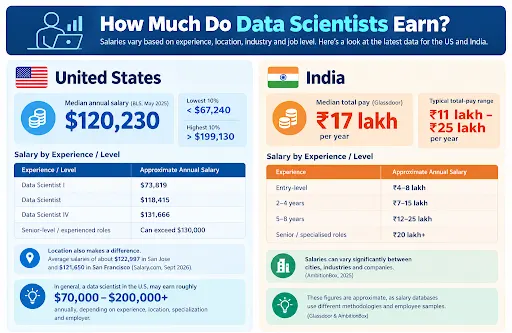
Data Scientist Salary: How Much Do Data Scientists Earn?
Data scientists are in high demand and can be employed in many industries. As a result, their salaries are above average compared to many other academic professions.
Data Scientist Skills and Prerequisites
The use of AI and LLMs is increasingly relevant to data science. Furthermore, they should possess the following skills:
- Programming: Here, the Python programming language is widely used (pandas, scikit-learn, NumPy), while R is sometimes used as well. Clean, comprehensible code is valued more than exotic tricks.
- SQL: It is used to query and manage databases and is therefore one of the absolute basic skills.
- Statistics and mathematics: Probability theory, hypothesis testing, regression and linear algebra are required to understand why a model works or does not.
- Machine Learning: You should be familiar with the common methods from regression to decision trees and boosting to the basics of neural networks, and be able to properly validate a model, recognize overfitting, and select the appropriate evaluation metric.
- Data visualization: This involves using tools such as matplotlib, seaborn and Plotly, or BI tools such as Power BI and Tableau.
- Tools and environment: Other frequently used tools include Git, Jupyter, and Docker, and increasingly, MLOps basics. Experience with cloud platforms such as AWS, Azure, or Google Cloud can also be useful.
In addition to the aforementioned hard skills, a whole range of soft skills are also required. These include strong communication skills, in order to explain models and analyses. A certain level of business acumen is also advantageous, in order to be able to contextualize findings within a company.
Data Scientist, Data Analyst, Data Engineer: How the professional fields differ
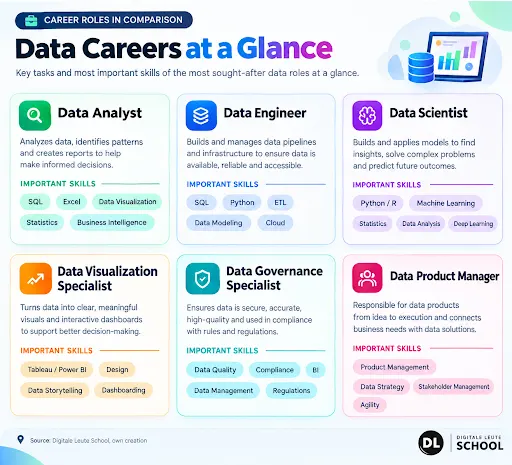
The job title of Data Scientist is often lumped together with other job titles such as Data Engineer or Data Analyst. Even though the areas of activity overlap, these are quite distinct roles.
What Does a Data Analyst Do?
The data analyst asks: What happened? They analyze existing data, build dashboards and reports, and provide departments with the key performance indicators (KPIs) they need to make informed decisions. Their toolkit primarily consists of SQL and visualization tools like Power BI or Tableau. Statistical depth is less important than the ability to present numbers in an understandable way.
What Does a Data Scientist Do?
The data scientist takes a different approach, asking: What will happen, and why? Instead of describing past events, they build predictive models, design experiments, and search for the causes behind observed patterns. This requires significantly more statistical and machine learning expertise, as well as solid programming skills in Python or R.
What Does a Data Engineer Do?
The data engineer, in turn, is responsible for the foundation on which both data analyst and data scientist work. Their question is: How can data be reliably, completely, and promptly delivered to where it’s needed? They build data pipelines, are responsible for data models and storage architecture, and ensure data quality and availability. Statistics play a minor role here; instead, cloud infrastructure and software engineering are central.
What Does an ML Engineer Do?
The field is often complemented by the ML Engineer, who transfers models from the prototype stage into production and keeps them stable there. Their responsibilities can vary by organization, and they often work across data science and data engineering tasks.
Also Read: Data Analyst Career Path Explored