


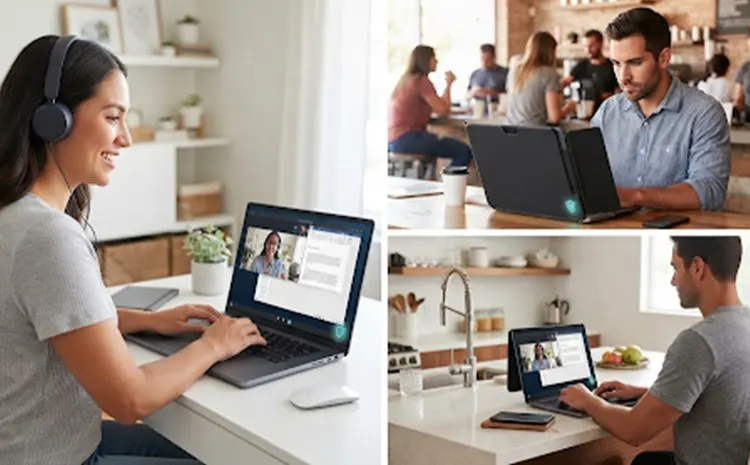
When most employees worked from a single office, protecting the business’s technology largely meant protecting one network and a defined set of devices sitting behind it. Remote and hybrid work has changed that picture significantly, multiplying the number of individual devices, locations, and networks a business now needs to consider part of its security perimeter. Endpoint protection, the practice of securing individual devices rather than relying primarily on network-level defenses, has become correspondingly more important as a result.
Why the Traditional Security Perimeter No Longer Applies
Traditional network security assumed a fairly clear boundary between the business’s internal network and the outside world, with most security effort focused on defending that boundary. Remote work has effectively dissolved that boundary, since employees now regularly connect to business systems from home networks, coffee shops, and other locations the business has no direct visibility into or control over.
This shift means a laptop used from a home office is now effectively an extension of the business network, but without the same layered defenses, like a business-grade firewall, that would normally protect it inside the office. Endpoint protection exists specifically to address this gap, providing security directly on the device itself rather than depending entirely on the network it happens to be connected to.
What Modern Endpoint Protection Actually Covers
Endpoint protection has evolved considerably beyond traditional antivirus software, which primarily looked for known malware signatures. Modern endpoint protection typically includes behavioral monitoring that can detect suspicious activity even when it does not match a known threat signature, automated response capabilities that can isolate a compromised device before an issue spreads, and centralized visibility that lets an IT team monitor the security status of every device across the business, regardless of where that device is physically located.
This centralized visibility matters significantly for remote teams, since it gives businesses a way to maintain oversight of devices that are never physically present in the office and would otherwise be difficult to monitor consistently.
The Specific Risks Remote Devices Introduce
Remote devices face risks that devices confined to a secured office environment typically do not. Home networks are frequently secured with consumer-grade routers that lack the security features found in business networking equipment. Personal devices used for work, in businesses that allow this, may lack the security controls and monitoring that a business-owned and managed device would have. Public Wi-Fi networks, used occasionally by remote and traveling employees, introduce additional risk that a device connecting only from a secured office would never encounter.
Endpoint protection helps address these risks directly by securing the device itself, rather than depending on the security of whatever network it happens to be connected to at any given moment.
Why Centralized Management Matters as Teams Grow
As a business adds remote employees, manually managing security on each individual device becomes increasingly impractical. Centralized endpoint management allows an IT team to deploy security updates, monitor device status, and respond to potential threats across the entire fleet of devices from a single system, rather than requiring individual attention to each device separately.
This becomes particularly important during a security incident. A centralized system that can quickly identify which devices might be affected and isolate them from the network reduces response time significantly compared to a scenario where each device needs to be individually assessed and addressed.
Balancing Security with Employee Experience
Effective endpoint protection needs to function without creating so much friction that employees actively try to work around it. Security measures that noticeably slow down a device or interrupt work constantly tend to generate resistance, and resistance sometimes leads employees toward risky workarounds, like disabling security features or using unmanaged personal devices to avoid the friction entirely.
Businesses that choose endpoint protection tools designed to run efficiently in the background, and that communicate clearly with employees about why these protections matter, tend to see stronger compliance and fewer attempts to bypass the system than those that treat security purely as a technical mandate without addressing the employee experience.
What to Look for When Evaluating Endpoint Protection Solutions
Businesses evaluating endpoint protection tools should look specifically for behavioral detection capabilities that go beyond simple signature matching, centralized management that provides visibility across all devices regardless of location, and automated response features that can contain a threat quickly without requiring manual intervention for every incident. It is also worth asking how the solution performs on typical remote work hardware, since a tool that significantly slows down an older laptop is more likely to generate employee resistance.
How Mindcore Technologies Helps Businesses Secure Remote and Hybrid Teams
Mindcore Technologies has spent more than 30 years helping businesses extend strong security practices to remote and hybrid teams without sacrificing the employee experience. Under the leadership of Matt Rosenthal, CEO of Mindcore Technologies, the company delivers AI-powered IT and cybersecurity solutions that include endpoint protection and centralized device management built for the realities of a distributed workforce.
Businesses working with Mindcore get consistent visibility and protection across every device, regardless of where employees are actually working from.
Conclusion
The shift toward remote and hybrid work has fundamentally changed what businesses need to secure, moving the security perimeter from a single office network to a distributed collection of individual devices operating in environments the business does not directly control. Endpoint protection has become the practical answer to this shift, providing security directly on each device and giving businesses the centralized visibility needed to manage a workforce that is no longer confined to a single location.
Also Read: Top Challenges Of Remote Work And Ways To Overcome Them